Cognitive Automation & AI Systems
Service Overview
We engineer foundational knowledge architectures for autonomous systems and reasoning engines. Our approach moves beyond statistical pattern matching to context-aware, goal-directed AI systems that reason over structured enterprise knowledge.
Core Capabilities
The Cognitive Automation & AI Systems service includes the following capabilities:
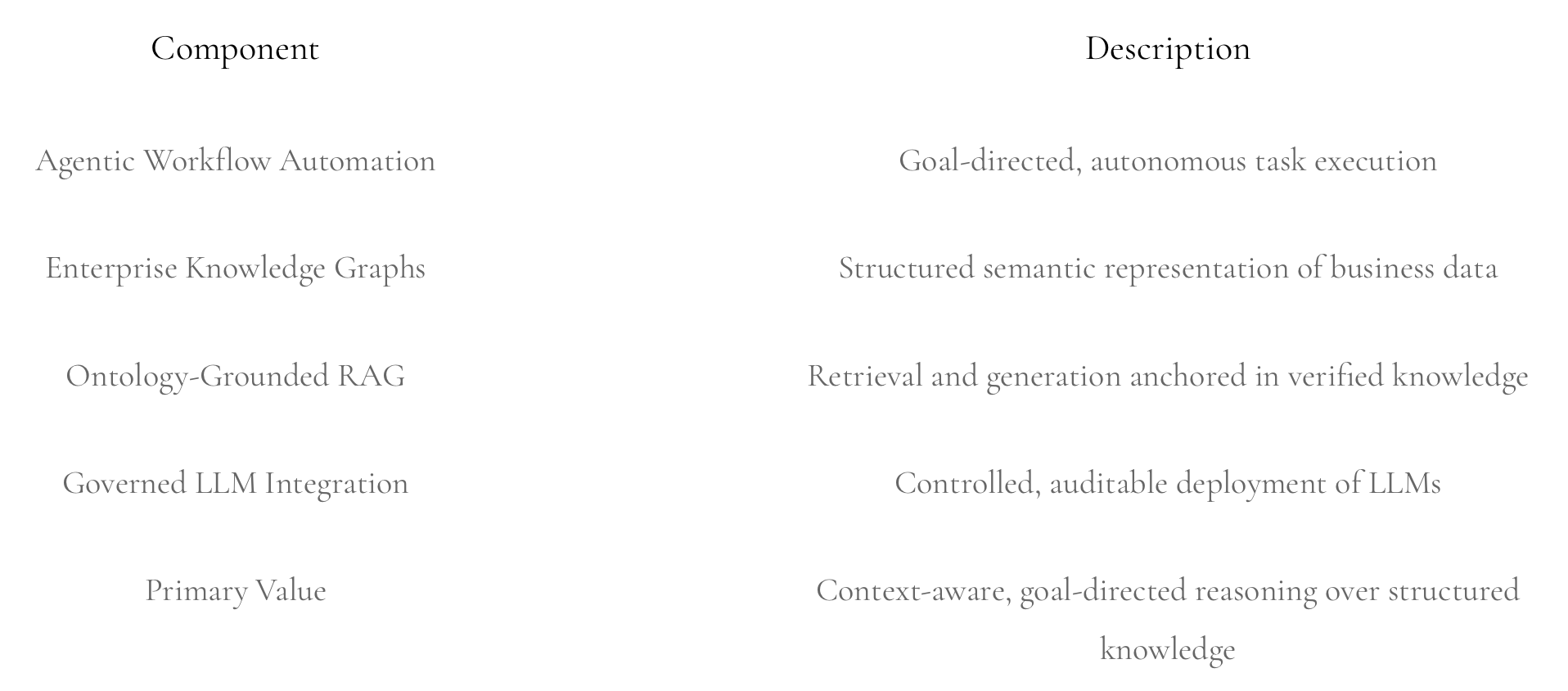
Agentic Workflow Automation
We design and implement systems that move beyond simple task automation to autonomous, goal-directed workflows. These systems can reason over structured enterprise knowledge to make decisions and take actions aligned with business objectives.
RAG Architectures Grounded in Verified Ontological Knowledge
We implement Retrieval-Augmented Generation (RAG) systems that are anchored in verified ontological knowledge. This grounding ensures that AI outputs are factually consistent with enterprise data and business rules, reducing the risks associated with ungrounded pattern matching.
Enterprise Knowledge Graph Development
We build comprehensive knowledge graphs that serve as the semantic backbone for AI systems. These graphs provide a structured, business-aligned view of enterprise data that enables consistent reasoning and context-aware automation.
Governed LLM Integration
We deploy large language models within a framework of governance and control. This includes implementing guardrails, access controls, and verification mechanisms to ensure that LLM outputs are compliant, auditable, and aligned with organizational policies.
Integrated Value
The integrated value of this service is enabling organizations to move beyond statistical pattern matching to context-aware, goal-directed AI systems that reason over structured enterprise knowledge. This shift provides:
AI systems that understand and operate within the specific context of your business
Structured knowledge architectures enable AI systems to understand organisational context. A knowledge graph combined with a memory management system allows AI agents to retain conversation history, reference company-specific knowledge at scale, and ensure that memory remains accurate and secure. By storing organisational relationships, processes, and data in a structured graph, the system enables precise retrieval of contextually relevant information for each interaction.
The practical impact is illustrated in customer support scenarios. When an AI system is augmented with a knowledge graph, it can ground its reasoning in structured entity relationships rather than relying on vague pattern matching. Without structured context, a system might produce a generic, imprecise response. With access to a verified knowledge graph, the system provides accurate, contextually relevant answers that reference specific organisational knowledge.
Enterprises are shifting from using large language models as the primary architecture to incorporating them as a component within a broader architecture that includes a semantic layer. This semantic layer provides governed meaning and context, enabling AI systems that are reliable, defensible, and trustworthy in high-stakes business domains.
Automation that is directed toward achieving defined business goals
Goal-directed automation represents a departure from rigid, scripted workflows towards adaptive systems that reason about what to do. Autonomous, goal-driven agents understand context, coordinate work across systems, and meet users where work happens. Traditional automation follows rules written in advance, while agentic systems make decisions at runtime using structured reasoning.
The transition from task execution to goal-directed execution is measurable. Multi-agent systems can be designed to minimise total execution time and task conflict cost, with specific objective functions driving task allocation decisions. This represents a shift from executing pre-defined sequences to optimising towards defined business objectives.
Practical applications demonstrate the value of goal-directed automation. Teams using goal-optimised agent fleets can streamline workflows and eliminate delays, significantly reducing project timelines. Specialised agents in a fleet collaborate towards shared goals, with each agent handling distinct responsibilities such as campaign setup, experience building, journey creation, recommendation generation, and compliance auditing.
Reasoning that is grounded in a verifiable, structured representation of your enterprise
Verifiable, structured representations of enterprise knowledge are foundational to reliable AI reasoning. Knowledge graphs provide a governed semantic layer that reduces the probabilistic nature of large language models and enables more consistent operation. Companies addressing the context problem are building systems that identify entities, relationships, time attributes, location attributes, and report the original sources of information.
The integration of a deterministic knowledge graph layer alongside reasoning frameworks provides an immutable, non-probabilistic foundation for AI outputs. By executing queries against structured fact graphs, AI agents can verify entity identities, active licensing, and institutional backing before building reasoning paths. This approach enforces strict verification boundaries and ensures that every claim is traceable to a source.
Enterprises are integrating operational data with knowledge graphs to create richer reasoning capabilities. An incident or service ticket can become a doorway into enterprise context when it is connected to topology, ownership, change activity, observability signals, security risk, historical incidents, and remediation knowledge. This gives both users and AI systems a richer way to reason about operations.
Greater reliability, auditability, and alignment with business outcomes
Reliability and auditability remain significant barriers to enterprise AI adoption. Hallucination rates remain a concern across language models, and many enterprises lack a clear strategy to measure reliability and move models into production. This leaves AI experiments confined to isolated use cases rather than delivering enterprise-wide impact.
Decision intelligence addresses these challenges by turning every AI choice into a permanent, auditable, queryable record. Key capabilities include:
-
Creating permanent, structured records of decisions that export to formats accepted by compliance frameworks
-
Building auditable causal chains linking decisions to their upstream causes and downstream effects
-
Providing semantic precedent search across all past decisions
-
Enabling full causal ancestry tracing back to root causes
-
Implementing policy compliance gates against configurable rule sets
This architecture ensures that in regulated domains, every AI decision is traceable to a source and defensible to an auditor. The approach supports alignment with international standards for AI management systems and auditability. Data provenance includes predicate-level verification, tying outputs back to official regulatory sources.
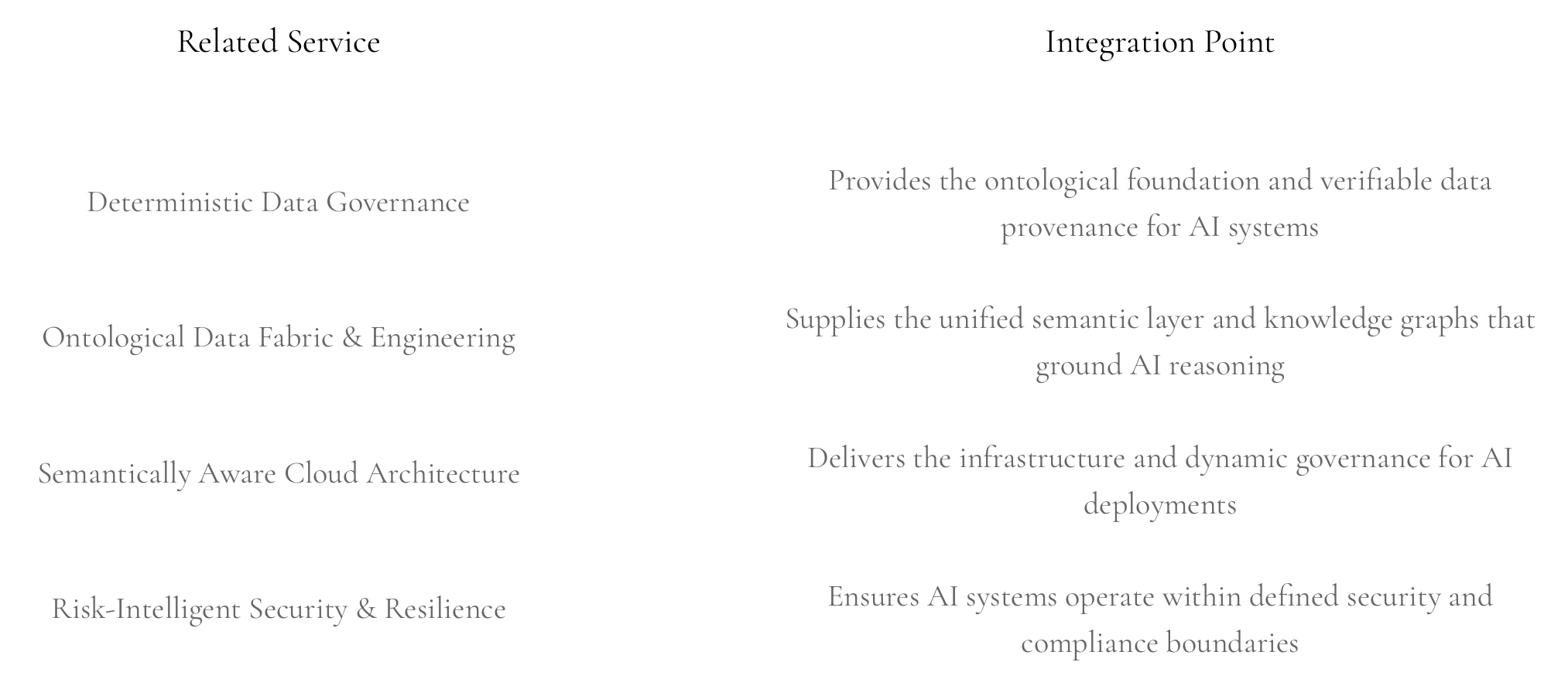
Related Services
This service integrates with our broader enterprise architecture practice:
Implementation Considerations
Organizations pursuing cognitive automation should consider:
Ontological Foundation
AI reasoning is only as reliable as the knowledge it rests upon. Establishing a verified ontological layer is a prerequisite for grounded AI.
Governance by Design
Compliance, security, and auditability must be engineered into the AI system from the start, not addressed as an afterthought.
Integration with Existing Data Fabric
Cognitive automation is most effective when it leverages a unified semantic layer that provides a consistent view of enterprise data.
Iterative Capability Building
Start with well-defined use cases and expand as the knowledge architecture matures and governance frameworks are validated.
In short